People often ask me what first drew me to design, and the honest answer is that working creatively was inevitable, as I grew up surrounded by art and design.
My father, Eric Gardiner, was an exhibition and interior designer, having trained at Hull College of Art and Design after serving in the Navy during the war. He was also a talented artist, and his own paintings of ships, churches and cathedrals still echo in the way I approach buildings today. Growing up our house was, by the standards of the time, incredibly modern. At weekends he painted, so being surrounded by art and design was the norm.
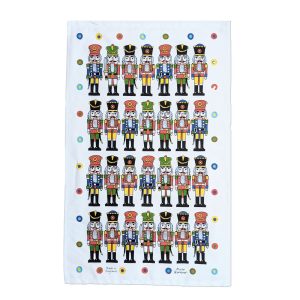
My mother shaped my eye just as much, if less visibly. She made our curtains herself, choosing fabric designed by Lucienne Day, one of the great names of the Festival of Britain era. Years after she died, I found the offcuts and framed them. These are still hanging on my wall today. She loved the National Trust shops, and our kitchen always had tea towels designed by Pat Albeck hanging up. I remember eating breakfast as a child, looking at those tea towels, and deciding I wanted to be a tea towel designer when I grew up. I had no idea, at seven years old, how literally that would come true.
Pat Albeck became something of a heroine of mine long before I understood why. It turned out she and my father had studied together at Hull, and my father always spoke of her with admiration. Years later, as a student, I discovered she was an external assessor at my college. I was in awe, and far too shy to say a word about the connection, or how much her work had shaped me.
My father died when I was eleven, so he never saw what I went on to do. I would love to have shown him the mugs, the illustrations, the exhibitions of buildings across London and Edinburgh that eventually led me to knock on doors at Ronnie Scott’s and the Groucho Club, selling paintings straight off the wall. I would love, too, to have finally told Pat Albeck what her tea towels meant to a small girl having her breakfast.
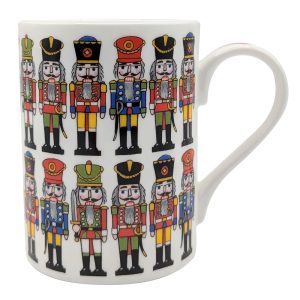
Looking back, none of it feels accidental. All of these influences found their way into a career that has now produced more than fifty mug designs for the National Trust alone, as well as for a number of other historical or religious sites. Good design, it turns out, really does stand the test of time.